922-MHz Spread-Spectrum Radio
922-MHz Spread-Spectrum Radio
RetiredNo longer available to order
This product is retained for service, documentation, and compatibility information.
Replaced by
- RF411A
922 MHz Spread-Spectrum Radio
- Warranty:
- 1 year
Overview
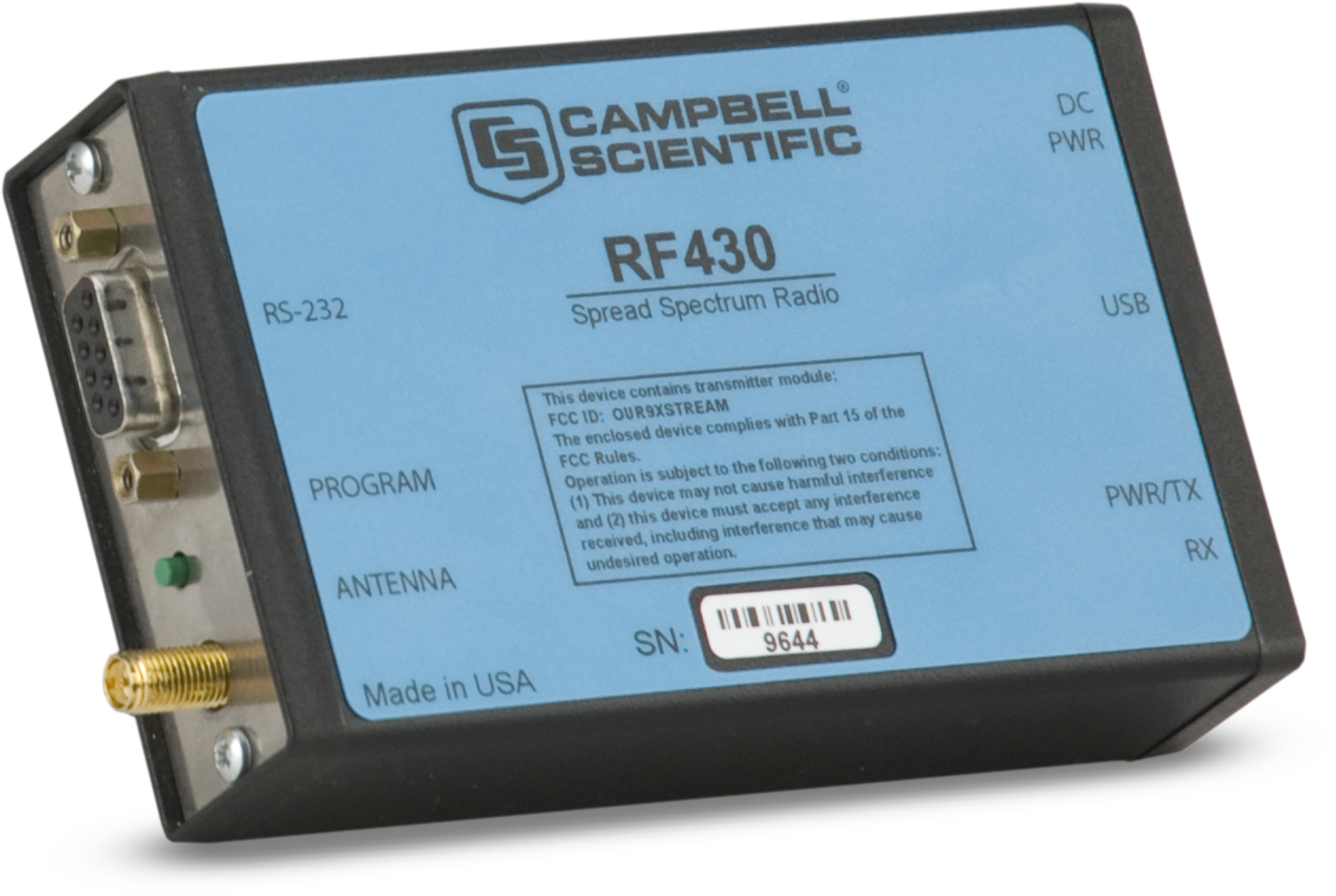
The RF431 spread-spectrum radio includes a USB port to make it easier to connect to newer computers that do not have RS-232 ports. This 100-mW spread-spectrum radio/modem operates in the 920- to 928-MHz frequency range, which is allocated for Australia/Israel. The RF431 can transmit data to another RF431 radio, an RF411 radio, or CR211(X) datalogger.
The RF431 supports point-to-point and point-to-multipoint communications. Although it typically serves as a base station modem/radio, the RF430 can connect to the datalogger’s RS-232 port to serve as a field modem (requires a null modem cable and a field power cable).
Technical Description
The RF431 reduces susceptibility to RF interference from other spread spectrum devices by providing user-selectable frequency hopping patterns. Spread spectrum radios spread the normally narrowband information signal over a relatively wide band of frequencies. This process allows communications to be more immune to noise and interference from RF sources such as pagers and cellular phones.
RF431 and RF411 Differences
The RF431 radio is functionally the same as the RF411. The difference between the two is that the RF431 has USB and RS-232 ports, while the RF411 has RS-232 and CS I/O ports.
Benefits
- Rugged, low-cost transceivers
- Can be used in the field as a transceiver or in the office as the base station
- Transmits up to one mile with omnidirectional antenna; up to 10 miles with higher gain directional antennas at ideal conditions
- Settings stored in non-volatile memory
- USB port for connecting to a computer; RS-232 port for connecting to a data logger
- Frequency-hops over 25 channels avoids interference from other spread spectrum radios
- Optional extended temperature testing
- Faster communication due to elimination of some small "link state packets"
- Ability to have stand-alone RF router/repeaters (up to 8 repeaters)
- Greater immunity to interference and RF collisions by using RF retries
- Reduced power consumption by the data logger, as the radios perform "packet address filtering"
- Built-in setup menus allow access to advanced functionality
- Designed for use in PakBus networks
Specifications
- Operating Frequency
- 920 to 928 MHz
- Type
- Frequency Hopping Spread Spectrum (FHSS) Transceiver
- USB Baud Rate
- 38.4k, 19.2k, 9600, 4800, or 1200 bps
If an RF431 radio has an operating system prior to OS2, its USB port will only communicate at 38.4 kbps. Therefore, the operating system of an RF431 radio may need to be updated to a newer version if the network will contain data loggers that do not support 38.4 kbps (e.g., CR200(X), CR510, CR10X). - RS-232 Data Rate
- 38.4k, 19.2k, 9600, 4800, or 1200 bps
- Channel Capacity
- 65,000 Network Identifiers share 25 hop channels.
- Frequency Hopping Patterns
- Six different selectable patterns
- Receiver Sensitivity
- -110 dBm at 10-4 bit error rate
(Campbell Scientific protocols will issue retries wherever a bit error occurs.)
- Interference Rejection
- 70 dB at pager and cellular phone frequencies
- Transmitter Power Output
- 100 mW
(nominal)
- Antenna Connector
- Reverse polarity SMA
- FCC ID
- OUR9XTREAM
- Power
- 9 to 16 Vdc
- LEDs
- Power on, TX, RX, diagnostics
- RS-232 Connector
- 9-pin “D” female
(4 wire: Tx, Rx, CTS, GND)
- Power Connector
- Barrel plug, center positive 12 V
(used to connect the 14291 Field Power Cable)
- Standard Operating Temperature Range
- -25° to +50°C
- Extended Operating Temperature Range
- -55° to +85°C
The push button that allows you to check/edit programmable settings while the radio is connected to a computer may not operate at temperatures colder than -25°C. - Dimensions
- 11.4 x 7.0 x 2.9 cm
(4.9 x 2.8 x 1.2 in.)
- Weight
- 227 g
(8 oz)
Average Current Drain
- Standby
- < 1 mA
(power-saving options used)
- Receiving
- 26 mA
- Transmitting
- 78 mA
Other Accessories
(12)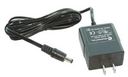
15966
Wall Charger with Barrel Plug
A 15966 wall charger allows ac power to serve as the radio's power source when the USB port is not used. This ac/dc transformer accepts inputs from 90 to 260 Vac @ 47 to 63 Hz, then outputs 12 Vdc @ 880 mA for use by the radio. The 15966 is fitted with a cable and barrel plug to connect the transformer to the radio. Cable length is 6 ft.
Orderable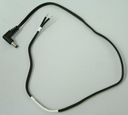
14291
Field Power Cable, 12 Vdc Plug to Pigtail
The 14291 power cable allows the radio to be powered from a suitable 12 Vdc battery. It is required if the radio is connected to a datalogger.
Orderable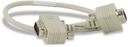
18663
Null Modem Cable, 9-Pin PIn (Male) to 9-Pin Pin (Male)
The 18663 is a 9-pin to 9-pin null modem cable used to connect the radio to the datalogger's RS-232 port.
Orderable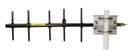
14201
900 MHz 9 dBd Yagi Antenna with Mounting Hardware
The radio requires the purchase of an antenna. A choice of six antennas is offered. The 14201 is a high-gain (9 dBd), directional (Yagi) antenna suitable for outdoor use. It has a narrow beam width, so precise aiming is mandatory. The 14201 is useful for longer distances and when communicating only with one other station (due to narrow beam width). The antenna has a TYPE N female connector and requires an antenna cable to connect it to the radio.
Orderable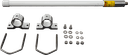
14221
900 MHz 3 dBd Omnidirectional Antenna with Mounting Hardware
The radio requires the purchase of an antenna. A choice of six antennas is offered. The 14221 has the highest gain (3 dBd) of our omnidirectional antennas. It is suitable for base station use where you need to communicate with multiple stations located in different directions. It's rugged FM2 antenna mounts will accommodate a vertical pipe of up to 2.5" (6.5 cm) outside diameter. The antenna has a TYPE N female connector and requires an antenna cable to connect it to the radio.
Orderable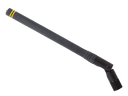
14204
900 MHz 0 dBd 1/2 Wave Omnidirectional Antenna with RPSMA Connector
The radio requires the purchase of an antenna. A choice of six antennas is offered. The 14204 is a unity gain (0 dBd) omnidirectional antenna. This antenna must reside inside a building or enclosure. It's right angle knuckle joint can be oriented vertically or at right angles. The 14204 attaches directly to the radio (antenna cable not required).
Orderable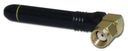
15730
900 MHz 0 dBd 1/4 Wave Omnidirectional Antenna with RPSMA Connector
The radio requires the purchase of an antenna. A choice of six antennas is offered. The 15730 is a unity gain (0 dBd), right angle, omnidirectional antenna that attaches directly to the radio (antenna cable not required). This antenna must reside inside of a building or enclosure.
Orderable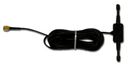
15970
900 MHz 1 dBd Omnidirectional Dipole Antenna with Adhesive Mount
The radio requires the purchase of an antenna. A choice of six antennas is offered. The 15970 is an omnidirectional antenna with a 1 dBd gain. It includes adhesive backing that adheres the antenna to a wall, rear-view mirror, window, or another suitable flat, non-conductive surface. A 79 in. cable is provided for attaching the antenna to the radio. The 15930 must reside inside of a building or enclosure.
Orderable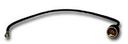
COAXRPSMA
LMR195 Antenna Cable with Reverse Polarity SMA and Type N Pin (Male) Connector
Either this cable or the COAXNTN (see below) is required when using the 14201 or 14221 antennas. The COAXRPSMA is an LMR 195 cable that terminates in a type N pin (male) connector on the "antenna end" and a Reverse Polarity SMA (RPSMA) pin (male) connector on the "transceiver end." It is recommended for applications where the cable length is less than 10 feet.
Orderable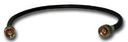
COAXNTN
RG8 Antenna Cable with 2 Type N Pin (Male) Connectors
Either this cable or the COAXRPSMA (see above) is required when using the 14201 or 14221 antennas. The COAXNTN is a low-loss RG8 coaxial cable that requires the 14462 surge suppressor to connect it to the radio. The COAXNTN/14462 combination is recommended over the COAXRPSMA when the antenna cable is longer than 10 feet (as measured between the transceiver and the antenna) or when the radio is used in an environment susceptible to lightning or electrostatic buildup.
Orderable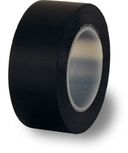
21212
Black Cold Shrink Tape
This 10 ft (3.1 m) roll of 1"-wide black self-vulcanizing tape can help protect the connection of outdoor antennas. After connecting the coaxial cable to the antenna, wrap the tape around the connectors that are exposed to the environment.
Orderable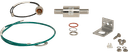
31314
Surge Protection Kit, Type N to RPSMA, 700 to 2700 MHz
The 31314 is an RF surge protection kit with flange mounting bracket. It may be flange-mounted to an enclosure backplate or bulkhead-mounted through an enclosure wall. One side of the surge protector connects to a radio with an RPSMA antenna connection. The other side connects to an antenna/antenna coaxial cable with Type N connector.
Orderable
Ships With
(2)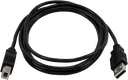
17648
USB Cable, Type A Pin (Male) to Type B Pin (Male), 6 ft
Orderable- 26689 Windows Driver CD
Compatibility
Note: The following shows notable compatibility information. It is not a comprehensive list of all compatible or incompatible products.
Communications
Other Spread-Spectrum Radios
Campbell Scientific does not recommend using the RF431 in networks containing FGR-115 or RF450 radios. However, RF431 radios can be used in networks containing RF411 and RF410 radios. RF431 radios in networks that include RF410 radios must use the Transparent protocol setting. Also, If RF410 and RF431 radios will be in the same RF proximity, do not use for the RF410 Net Address: 28, 44, 52, 56, or 60. RF410 radios with Net Addresses of 28, 44, 52, and 56 interfere with RF431 radios with Net Addresses of 0, 1, 2, and 3, respectively. The RF410 Net Address of 60 interferes with all RF431 Net Addresses.
Transparent and PakBus Protocols
Do not mix RF431 radios set to the Transparent protocol with RF431 or RF411 radios set to either of the PakBus protocols, since this will produce RF traffic without any RF communications. However radios with the PakBus Aware and PakBus Node settings can coexist in the same network (i.e., some radios set to PakBus Aware and some radios set to PakBus Node).
Data Logger Considerations
If an RF431 radio has an operating system prior to OS2, its USB port will only communicate at 38.4 kbps. Therefore, the operating system of an RF431 radio may need to be updated to a newer version if the network will contain data loggers that do not support 38.4 kbps (e.g., CR200(X), CR510, CR10X).
Compatible Products
(19)
Basic Datalogger
Basic Datalogger
RetiredNotes—
Basic Datalogger
Basic Datalogger
RetiredNotes—
CR6
High-Capacity Data Acquisition System
OrderableNotes—
CR10
Measurement and Control System
RetiredNotes—
CR200X
Datalogger
RetiredNotes—
CR206X
Datalogger with 900 MHz Spread-Spectrum Radio
RetiredNotes—
CR211X
Datalogger with 922 MHz Spread-Spectrum Radio
End of lifeNotes—
CR216X
Datalogger with 2.4 GHz Spread-Spectrum Radio
RetiredNotes—
CR295X
Datalogger for GOES Satellite Communication
RetiredNotes—
CR800
Measurement and Control Datalogger
RetiredNotes—
CR850
Measurement and Control Datalogger
RetiredNotes—
CR1000
Measurement and Control Datalogger
RetiredNotes—
CR3000
Measurement and Control Datalogger
RetiredNotes—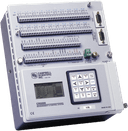
CR5000
Measurement and Control Datalogger
RetiredNotes—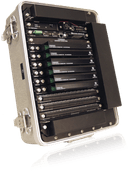
CR9000X
Measurement and Control Datalogger
RetiredNotesAlthough compatible, RF431 radios do not support the CR9000(X)'s fastest communication rates, and are therefore not practical for many of their applications.
Datalogger for Measurement and Control
Datalogger for Measurement and Control
RetiredNotes—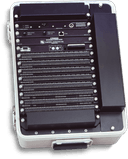
Measurement and Control System
Measurement and Control System
RetiredNotesAlthough compatible, RF431 radios do not support the CR9000(X)'s fastest communication rates, and are therefore not practical for many of their applications.
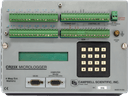
Micrologger for Data Acquisition
Micrologger for Data Acquisition
RetiredNotes—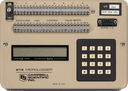
Micrologger®
Micrologger®
RetiredNotes—
Related Resources
Documents
Downloads
Product Life Events
- Available for Order
- December 14, 2009
- Calibration Available Until
- March 28, 2014
- Retired
- March 28, 2014
- Free Support Until
- March 31, 2024
- End of Life
- March 31, 2024
- Repair Available Until
- March 31, 2024