Micrometeorology and Gas Flux Solutions
Defensible Data Without Compromise
As environmental conditions shift and climate dynamics become more complex, accurately measuring gas flux and turbulence is critical to understanding how ecosystems respond. These measurements form the foundation for quantifying carbon exchange, energy balance, and long-term environmental change.
Campbell Scientific delivers fully integrated gas flux and turbulence systems for eddy covariance and other micrometeorological methods. These solutions are designed to capture the complete complexity of atmospheric turbulence and greenhouse gas fluxes, including CO₂, H₂O, CH₄, and N₂O. They also monitor critical energy exchanges such as sensible heat, latent heat, and momentum.
When precision, reliability, and efficiency are non-negotiable, Campbell Scientific sets the environmental monitoring standard.
Connect with a Micromet ExpertStay ahead of innovation and advance research capabilities without overspending.
Using a flexible open-architecture design, Campbell Scientific gas flux and micrometeorology systems work smoothly with both Campbell Scientific sensors and many third-party sensors. As new technologies emerge, you can easily integrate them into your existing system. This protects your investment, extends its lifespan, and keeps you at the forefront of innovation.
Research-grade systems built and backed by experts
From system design to long-term operation, our expert practitioners help you design, install, and operate systems that produce defensible flux data. Whether your station is turn-key or self-installed, we provide measurement and theory guidance to ensure reliable, high-quality data.
True measurement synchronicity
Some solutions rely on separate sensors' clocks to synchronize gas analyzer and sonic anemometer measurements, but these clocks can drift at different rates over time, resulting in unsynchronized data. Campbell Scientific micrometeorology and gas flux solutions are different: by using a common set of electronics to measure the time of the individual sensor's measurements, you can feel confident that your measurements are truly in sync.
Free from proprietary, "black box" data
From data collection to post-processing, you own your data and data management. This brings visibility and transparency to the entire process and enhances data defensibility.
Built for performance where it matters most
Across the total operating range, our eddy-covariance systems offer the lowest total system power consumption on the market today (just 5 W for open-path configurations and 12 W for closed-path configurations). This exceptional efficiency—combined with rugged, field-proven designs and minimal maintenance requirements—makes Campbell Scientific solutions the go-to answer for monitoring gas fluxes, especially in remote or challenging environments.
Featured Micrometeorology and Gas Flux Equipment
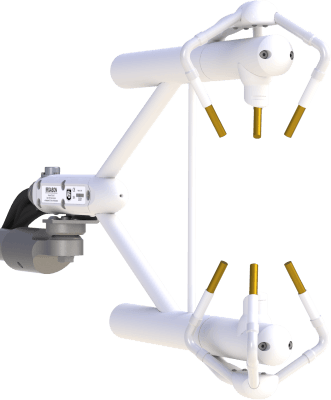
IRGASON™ Integrated CO₂ and H₂O Open-Path Gas Analyzer and 3-D Sonic Anemometer
Combining an open-path gas analyzer and a sonic anemometer into a single instrument, the IRGASON brings true collocation to eddy covariance and water and carbon flux measurements.
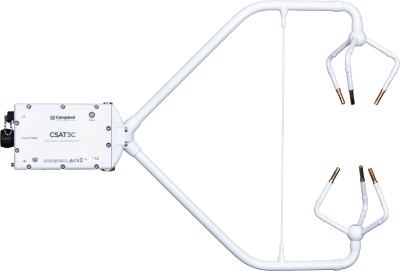
CSAT3C 3-D Sonic Anemometer for Demanding Flux Research
Commonly used in eddy-covariance applications, the CSAT3C builds on the trusted legacy of the CSAT series. By bringing Campbell Shield™ reliability to environmental monitoring, this 3-D anemometer is equipped to reliably and accurately measure in harsh and extreme environments.
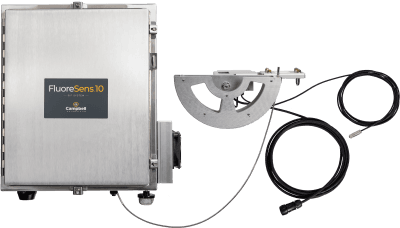
FluoreSens™10 Sun-Induced Chlorophyll Fluorescence (SIF) System
As an indicator of plant health, the FluoreSens 10 provides a direct sun-induced chlorophyll fluorescence (SIF) measurement. These measurements are used to estimate the two largest biospheric carbon sources: gross primary production (GPP) and ecosystem respiration (RECO).
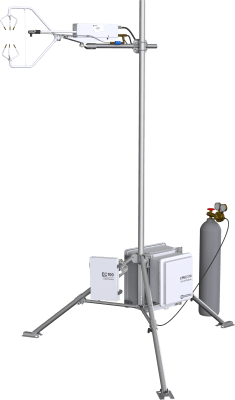
CPEC310 Expandable Closed-Path Eddy‑Covariance System
The CPEC310 is a top-of-the-line, fully integrated, turn-key, closed-path eddy-covariance flux measurement system engineered for use on either short or tall towers that will use automatic zero and span.
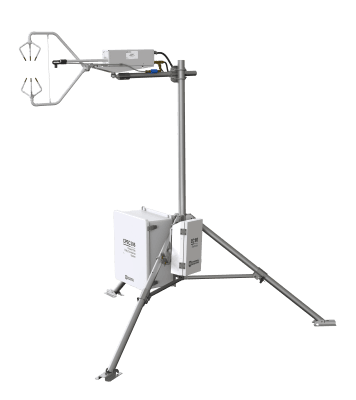
CPEC306 Expandable Closed-Path Eddy‑Covariance System
As a fully integrated, turn-key, and expandable eddy-covariance system, the CPEC306 is ideal for sites with either a short or tall tower.
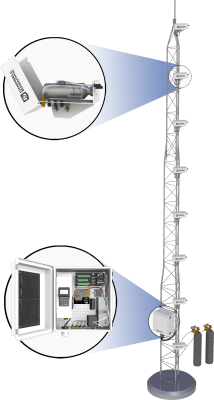
AP200 CO₂/H₂O Atmospheric Profile System
This complete, integrated, and low-power CO₂ and H₂O atmospheric profiling system used in conjunction with an eddy-covariance system provides enhanced data about the surface gas exchange.
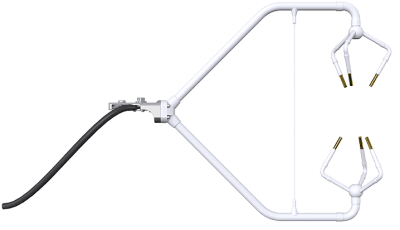
CSAT3A 3-D Sonic Anemometer, Head Only
The CSAT3A is a 3-D sonic anemometer (head only) used in eddy-covariance measurements. The CSAT3A offers precision flux measurements and is often coupled with the EC150 or EC155 gas analyzers to represent a more holistic eddy-covariance measurement.
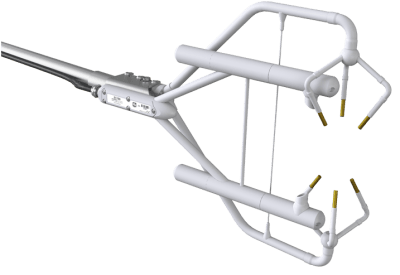
EC150 CO₂/H₂O Open-Path Gas Analyzer
Open-path gas analyzer used to monitor carbon and water fluxes in eddy-covariance research and operational applications. Typically paired with the CSAT3A.
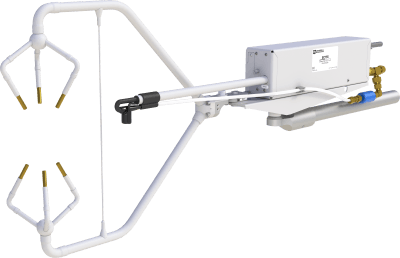
EC155 Closed-Path CO₂/H₂O Gas Analyzer
The EC155 is a closed-path gas analyzer used to reduce maintenance and improve performance in corrosive environments. The EC155 measures wide ranges of CO₂, H₂O, pressure, and temperature. In most applications, this sensor is paired with the CSAT3A to represent a more holistic, complete measurement.

EasyFlux™ DL Eddy-Covariance Data Logger Program
Report fully corrected fluxes of CO₂, latent heat, sensible heat, and momentum from Campbell Scientific open-path and closed-path eddy-covariance systems.
Case Studies
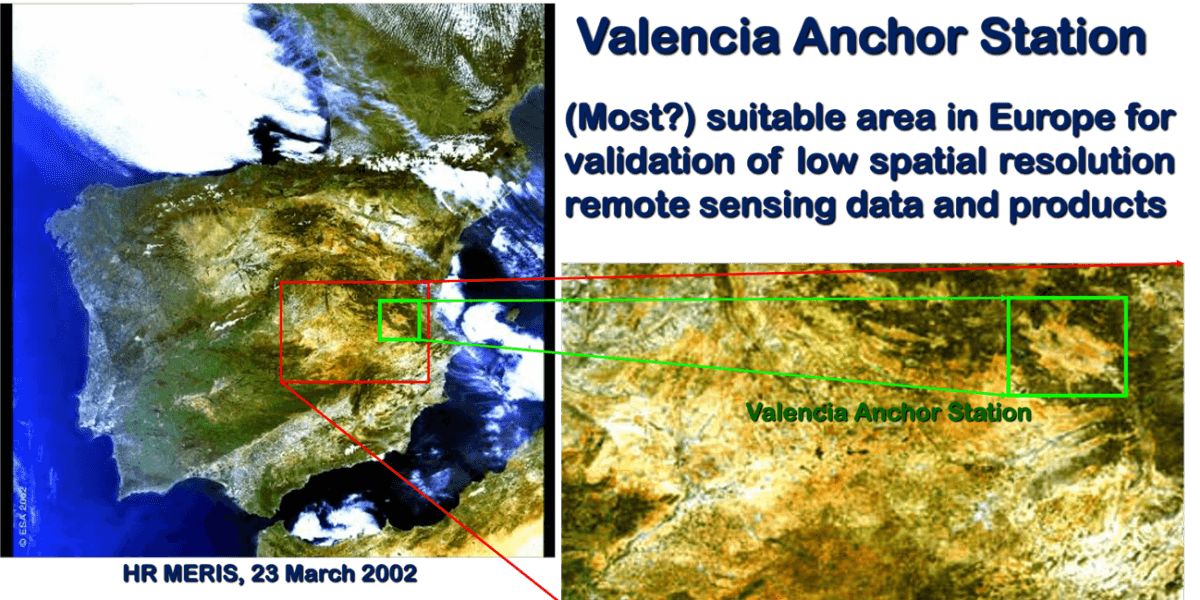
Spain: Strengthening Satellite Validation and Carbon Flux Research
Explore how one of Europe’s most important Earth Observation (EO) stations validates satellite data with an IRGASON open-path eddy-covariance system.

See how Qingyuan Forest CERN, the Chinese Academy of Sciences, and Ker Joint Laboratory used Campbell Scientific gear to perform flux studies over heterogeneous landscapes.
Learn from Our Experts

Measure More, Lock in Less: The Open Approach to MicroMet Data
When making micrometeorology measurements, accurate, reliable data monitoring systems that can grow and improve as science advances is critical. In this webinar, Dr. Ben Conrad, Director of Micrometeorology at Campbell Scientific, explores the hidden costs, innovation slowdowns, and lack of flexibility associated with proprietary, closed micrometeorology system architectures. Plus, he highlights an alternative framework that puts your data, and your system growth, in your hands. Finally, he gives you a practical framework for evaluating your system's flexibility.
FluoreSens™10 Webinar: Complete Solution for Your SIF and Vegetative Indices Measurements
In this recorded webinar. Dr. Prajaya Prajapati of Campbell Scientific introduces this ready-to-use system.
Considerations for Your Campbell Scientific Eddy-Covariance System: A Webinar
In this recorded webinar, Dr. Ben Conrad of Campbell Scientific explores the important implications of eddy-covariance systems.
Highlighted Research
Accuracies of field CO2–H2O data from open-path eddy-covariance flux systems: assessment based on atmospheric physics and biological environment
Benefits of Having a Co-Located Measurement
Recovery of the three-dimensional wind and sonic temperature data from a physically deformed sonic anemometer
Using Molecular Sieve to Zero Infrared Gas Analyzers for Eddy Covariance or Atmospheric Profile Measurements
Influence of Open-path Gas Analyzer Flow Distortion on Ultrasonic Wind Measurements
High-Frequency Air-Temperature Fluctuations for Spectroscopic Corrections
You Might Also Like...
Upcoming Events
See where the Campbell Scientific Micrometeorology team is next exhibiting at conferences.
Connect with a Micromet Expert
Have questions about eddy covariance systems, gas flux measurement, or system configuration? Our team is ready to help.