Measurement and Control Products for WEATHER Measurement and Control Products for WATER Measurement and Control Products for ENERGY Measurement and Control Products for MACHINES Measurement and Control Products for STRUCTURES Measurement and Control Products for EARTH
Current Products
 No Retired

Air Temperature Sensors

Campbell Scientific offers thermistors, thermocouples, and RTDs for measuring air temperature. The datalogger's programmability allows a variety of measurement options and output in units of...

Air Temperature & Relative Humidity

Air temperature and relative humidity probes typically consist of two separate sensors packaged in the same housing. Often relative humidity is measured with a capacitive...

Barometric Pressure Sensors

Barometric pressure sensors measure fluctuations in the pressure exerted by the atmosphere. The sensors require protection from condensing humidity, precipitation, and water ingress and are...

Basic Weather

These sensors measure wind speed and direction, precipitation, barometric pressure, temperature, and relative humidity—all in a single device that has no moving parts.

Conductivity Sensors

Conductivity sensors measure how well a solution conducts a current. The more ions that are in the solution, the higher the conductivity.

Digital Camera

If you believe a picture is worth a thousand words, our digital camera is just what you need! Designed to work in harsh environments with...

Dissolved Oxygen Sensors

Dissolved oxygen is a critical parameter in determining the health of aquatic systems. In many aquacultural applications, measurement of decreased oxygen levels is used as...

Distance Sensors

The most common applications are measuring snow depths and water levels. Ultrasonic sensors determine the distance to a target by sending out ultrasonic pulses and...

Duff Moisture Sensors

Duff is an important component of forest fire fuel. An accurate knowledge of moisture content in duff material is critical to those conducting scheduled burns...

Electrical Current Sensors

Electrical current sensors detect the flow of current along an electrical wire by measuring (or sensing) the magnetic field that is set up by the...

Electric Field Sensors

Like electrical charges repel and unlike charges attract. An electric force field, referred to as an electric field, is said to exist around electrical charges....

Evaporation

Evaporation gages determine the evaporation rate by measuring the changing water level in an evaporation pan. They consist of a float, pulley, and counterweight attached...

Freezing-Rain and Ice Detectors

Freezing rain sensors detect the presence of icing conditions so that appropriate actions can be taken to prevent damage to power and communication lines, to...

Fuel Moisture and Fuel Temperature

Campbell Scientific offers sensors that emulate and measure the moisture content and temperature of similarly-sized twigs on the forest floor. These 10-hour fuel moisture and...

GPS Global Positioning Sensors

These sensors use Global Positioning Satellites (GPS) to determine position. There are three segments in determining position: satellites, ground stations, and sensors. The sensors access...

Heat, Vapor, and CO2 Flux

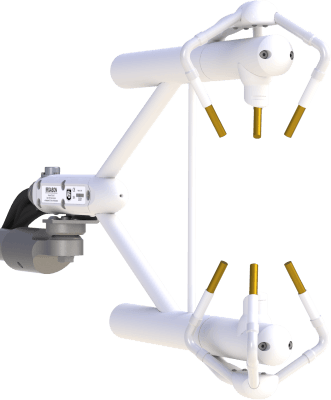
By finding the covariance between the vertical wind speed fluctuations with temperature against humidity and carbon dioxide fluctuations, the sensible and latent heat flux, as...

Infrared Gas Analyzers

Campbell Scientific offers both open-path and closed-path infrared gas analyzers that measure carbon dioxide, water vapor, temperature, and pressure. These analyzers feature aerodynamic designs to...

Leaf Wetness Sensors

There are three leaf-wetness sensors classifications:

  1. Surface contact types that measure the electrical resistance of a water film on the leaf surface,
  2. Mechanical types that detect a...

ORP Sensors

Our ORP sensors measure the Oxygen-Reduction Potential of a solution. Used in tandem with a pH sensor, the ORP measurement provides insight into the level...

pH Sensors

Our pH sensors measure the hydrogen ion concentration of a solution. The greater the hydrogen ion concentration, the smaller the pH; when the pH is...

Precipitation Sensors

Campbell Scientific offers several types of precipitation measuring devices: tipping bucket rain gage, siphoning tipping bucket rain gage, heated rain gage, and a snowfall adapter....

Present Weather

Present Weather Sensors are often a component of road, marine, and airport automated weather stations. They use a laser-based system to determine visibility, measure precipitation...

Road Weather and Surface Conditions

Campbell Scientific has sensors and measurement systems that provide data to monitor the atmospheric conditions near roadways as well as the conditions on the actual...

Roadbed Water Content

Products for evaluating the volumetric and gravimetric water content of roadbed material both at the construction site and in the soil-test lab.

Snow Water Equivalency and Snow Depth

This section contains sensors that measure the amount of water contained within a snowpack or the depth of the snowpack.

Soil Heat Flux Sensors

Heat flux sensors measure the rate of energy transferred through a given surface. The sensors can be several thermocouples whose measurements are averaged, a thermopile,...

Soil Temperature Sensors

Thermistors, thermocouples, thermocouple wire, and averaging thermocouples are standard soil temperature sensors that are available. Campbell Scientific dataloggers are capable of measuring most commercially available...

Soil Volumetric Water Content

Soil water content indicates how much water is present in the soil. It can be used to estimate the amount of stored water in a...

Soil Volumetric Water Content Profiles

These probes monitor soil water content profiles. They can measure soil moisture at multiple depths and are easy to install. The output type can be...

Soil Water Potential Sensors

Soil water potential sensors determine the energy status of water in soil. The energy state describes the force that holds the water in the soil....

Solar Radiation Sensors

Campbell Scientific offers pyranometers, net radiometers, and quantum sensors, all designed to measure various aspects of the energy imparted by the sun on the Earth's...

Strain Gages

Strain gages are used to quantify live loads by measuring induced strains on various types of structures and components.

Surface Temperature Sensors

We offer two different technologies to measure surface temperature. Infrared temperature sensors are a non-contact means of measuring the surface temperature of an object or...

Turbidity Sensors

Turbidity sensors measure suspended solids in water, typically by measuring the amount of light transmitted through the water. They are used in river and stream...

Water Level, Stage, & Flow Sensors

Water level, stage, or flow can be measured with many types of sensors: pressure transducers, bubblers, shaft encoders, or ultrasonic sensors. The location where you...

Water Samplers

Campbell Scientific offers both portable and stationary automatic water samplers for storm water, waste water, or other water-quality applications. These samplers use external vacuum pumps...

Water Temperature Sensors

Our thermistors are versatile, rugged temperature sensors optimized for long-term deployment. They can monitor water temperature for depths up to 50 feet. The thermistor circuit...

Wind Speed and Wind Direction

Campbell Scientific offers a selection of quality wind sensors. Our wind vanes and anemometers are used in research, air quality, and general purpose meteorological applications....

Wireless Sensors

The CWS family of wireless sensors expands measurement possibilities by allowing sensors to be installed at a distance from the datalogger without cables. We offer...

Resources and Links

About Sensors

Our sensors are generally designed for long-term installation under adverse environmental conditions. Most of the sensors listed on our web site measure environmental and water resources parameters, but our dataloggers are not limited to measuring environmental sensors. Sensors used in industrial applications such as strain gages, accelerometers, hydraulic pressure transducers, are also available, either through our applications engineers or from a third party.

Our dataloggers have many channel types and programmable inputs, enabling them to measure most commercially available sensors. Sensors that output voltage, pulse, SDI-12, RS-232, or 4-20 mA signals can be read using the datalogger's analog (single-ended and differential), pulse counter, SDI-12, RS-232, continuous analog output, digital I/O, anti-aliasing filter, and switched excitation channels.

FAQs for

Can I add more cable to my sensor?

Can you replace your old cable with a new, longer cable? Sometimes, but not always.

Can you splice on additional cable? Our quick and easy response is no. However, there are some exceptions. You'll need to contact one of our applications engineers to discuss your sensor in detail.

What are some of the problems you could encounter by splicing cable? Some of our sensors have bridge completion resistors at the pigtail end, others are calibrated to length, sometimes the color in the insulation may not be the same as those visible at the pigtail end, or you could introduce errors or malfunctions depending on the integrity of the splice. Give us a call and we'll give you an answer based on your specific probe.

How do long cable lengths affect my measurements?

Voltage Measurements

The effect of long cable lengths on analog measurements depends on the type of measurement that is made. For example, long lead lengths do not affect differential measurements of passive sensors, e.g. thermocouples, thermopiles, photo diodes, or active sensors that have a separate lead for the signal reference and the power ground, e.g. the HMP45C temperature and humidity sensor or the CS105 barometric sensor. Making a differential measurement on an active sensor that shares the same lead for the signal reference and power ground, e.g. the CS500 temperature and humidity or the LI-6262 infrared gas analyzer, does not eliminate the effects of long lead lengths.

So, what is the problem with long lead lengths? Well the problem is that when current flows through a ground wire there is a voltage drop. The voltage drop follows Ohm’s law and causes an apparent voltage increase between the signal lead and the signal reference lead. This voltage drop occurs because wires have resistance. Long lengths of wire have more resistance than short lengths. Thus, long lengths of wire will cause a larger voltage drop than shorter lengths. Also, the voltage drop is more pronounced in active sensors (sensors that require 12 Vdc to operate), e.g. CS500 temperature and humidity sensor or LI-6262 infrared gas analyzer, than in passive sensors, because there is more current flowing in the ground wires of the active sensors.

The HMP45C draws approximately 4 mA @ 12 Vdc when it is powered. The cable (P/N 9721) used in the HMP45C has resistance of 27.7 W/1000 feet. For a Single Ended Measurement (Instruction 1) the signal reference and the power ground are both connected to ground at the datalogger, the effective resistance of those wires together is half of 27.7 W/1000 feet, or 13.9 W/1000 feet. Using Ohm’s law the voltage drop, Vd, along the signal reference/power ground, is given by equation below.
Vd = I * R
?????=4 mA * 13.9 Ohms/1000 ft
?????=55.6 mV/1000 ft
This voltage drop will raise the apparent temperature and relative humidity because the difference between the signal and signal reference lead, at the datalogger, has increased by Vd. The approximate error in temperature and relative humidity is 0.56°C and 0.56% per 100 feet of cable length, respectively.

Since the HMP45C is fitted with both a wire for the signal reference and power ground, its output can be measured using a Differential Measurement (Instruction 2). The voltage drop, as described above, will not occur on the signal reference lead, because the datalogger’s High and Low Analog Input Channels, used to make a differential measurement, are high impedance, i.e. no current can flow into them.

In general, use a Differential Measurement to measure sensors with long lead lengths. For sensors that require 12 Vdc to operate, use two separate leads for the signal reference and the power ground.

Bridge Measurement

The signal from bridge measurements suffer the same voltage drops when long lead lengths are used to connect the bridge to the datalogger (see the above section). Again, a differential measurement, as used in the 4 Wire Half Bridge (Instruction 9) or 6 Wire Full Bridge (Instruction 9), can be used to eliminate this voltage drop. There are two additional complications in bridge measurements, the excitation voltage and the setting time.

Bridge measurements require that the datalogger excite the bridge with a precision excitation voltage. When long lead lengths are used to connect the bridge to the datalogger, the excitation voltage, at the bridge, will be less than the excitation voltage at the datalogger. This voltage drop is caused by the resistance of the wires connecting the bridge to the datalogger’s excitation channel. The excitation voltage drop can be compensated for by using a 3 Wire Half Bridge (Instruction 7), 4 Wire Half Bridge (Instruction 9), or 6 Wire Full Bridge (Instruction 9) measurement.

It takes a finite amount of time for the excitation voltage and signal voltage to stabilize to its true value. This time will vary with the lead length. For more information see the "Effect of Sensor Lead Lengths on the Signal Settling Time" section in the datalogger manuals (Section 13).

In general, if long lead lengths are required for bridge measurements, use the 3 or 4 Wire Half Bridge configuration over the 2 wire and the 6 Wire Full Bridge configuration instead of the 4 Wire Full Bridge. See the "Bridge Resistance Measurements" section in the datalogger manuals (Section 13).

How many sensors can your dataloggers measure?
The number of sensors that can be measured is determined by the sensor(s) and the datalogger(s). See the operators manual for your sensors to determine the channels each sensor uses, then go to our datalogger comparison chart available from this Web site for the number of analog channels, pulse counting channels, switched excitation channels, digital ports, and continuous analog ports provided by your datalogger.
Home \ Products \ Components \ Sensors