TX321
TX321
End of lifeSatellite Transmitter for GOES or Meteosat
No longer available to order
This product is retained for service, documentation, and compatibility information.
Replaced by
- TX325
Satellite Transmitter for GOES CS2/v2.0
- Model:
- TX321
- Item Number:
- 32248
- Warranty:
- 1 year
Overview
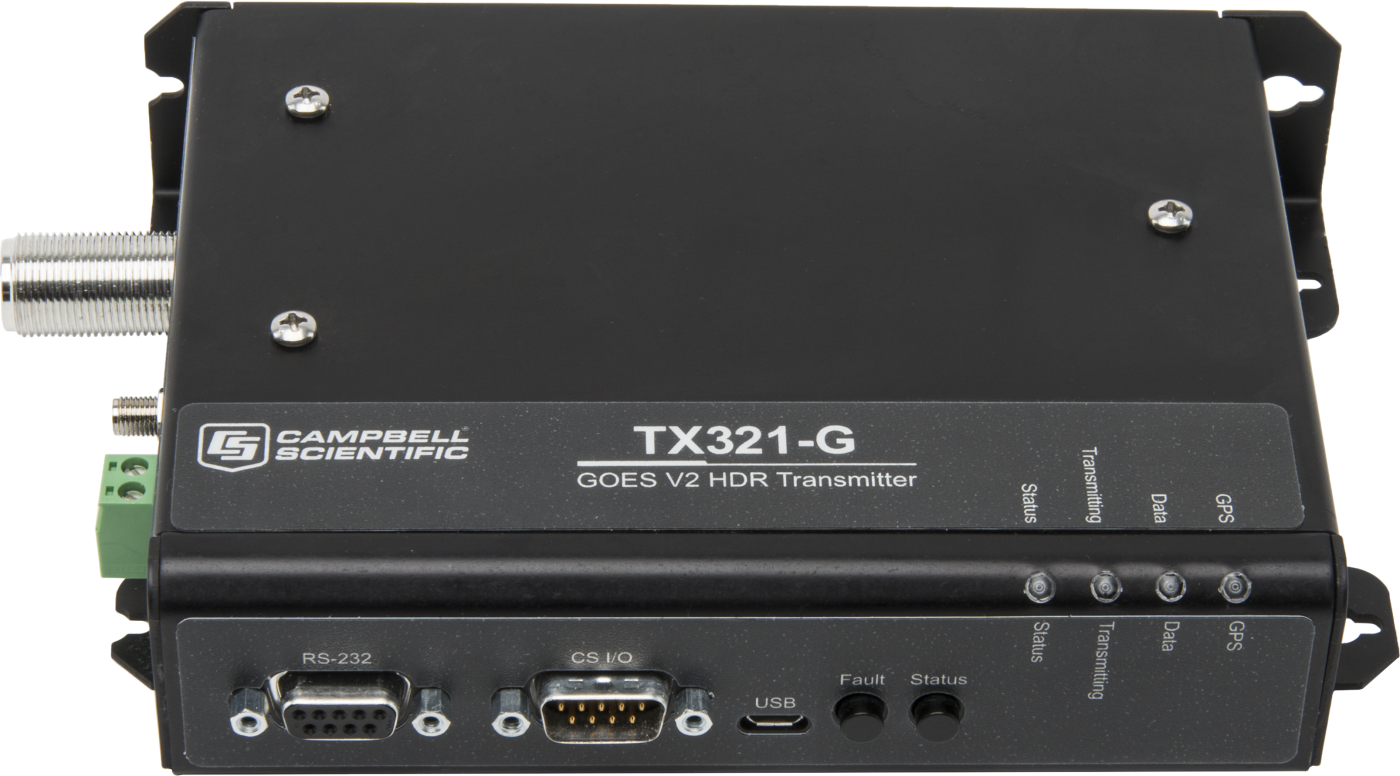
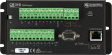
The TX321 is a GOES and Meteosat satellite data transmitter. It provides an easy and reliable way for Campbell Scientific data collection platforms (DCP) to transmit data over geostationary satellites. The TX321 is typically used by government agencies and sponsored research organizations for the purpose of collecting environmental data.
Technical Description
The TX321 is designed for use on the NOAA GOES Data Collection System and the EUMETSAT Meteosat Data Collection Services satellite networks. These networks use geostationary satellites and ground stations to receive and relay data transmitted from remote data collection platforms (DCP), such as those provided by Campbell Scientific. These DCPs are typically owned and operated by government agencies and sponsored research organizations. Users are given a frequency and time slot for their transmissions.
Data Collection Platform (DCP) Equipment
- TX321 Satellite Transmitter
- 17992 or 31182 GPS antenna and their antenna mounts and coaxial cables
- 25316 11 dBi Right-Hand Circular Polarized (RHCP) Yagi antenna and coaxial cable
- Data logger
- Power supply, such as Campbell Scientific’s BP12 or BP24 battery, CH150 or CH200 charge regulator, and SP10 10 W or SP20 20 W solar panel
GOES System Authorization Procedure
Non-U. S. government agencies and research organizations must have a sponsor from a U.S. government agency. Prospective GOES users must receive formal permission from NESDIS, by doing the following:
- Fill out the System Use Agreement (SUA) application form. The form can be submitted online or sent to:
GOES DCS SUA Processing Unit NOAA,
Satellite Services Division
4231 Suitland Road, Rm 1646
Suitland Federal Center Suitland, MD 20746
Tel: 301-817-4563
Fax: 301-817-4569
Email: Letecia.Reeves@noaa.gov - Following approval, NESDIS sends a Memorandum of Agreement (MOA). The MOA must be signed and returned to NESDIS.
- After the MOA is approved, NESDIS will issue a channel assignment and an ID address code.
- NESDIS must be contacted to coordinate a start-up date.
Meteosat System Authorization Procedure
Complete and submit the EUMETSAT DCP Admission form.
Benefits
- GOES High Data Rate Version 2, Meteosat SRD, and International DCS operation
- Very low power consumption when idle (< 5 mA @ 12V)
- Transmissions continue for 28 days if GPS is lost
- Configuration and diagnostics easily performed by data logger or computer
- Drop-in replacement for Campbell Scientific TX320, TX312, and SAT HDR GOES
Specifications
- Transmission Distance or Area
- GOES: North AmericaMeteosat: Europe
- Transmissions Supported
- Timed and randomASCII and pseudo-binary message
- Transmit RF Out Connector
- Type N jack
- Radio Module
- G6 OEM
- Operating Temperature Range
- -40° to +60°C
- Storage Temperature Range
- -55° to +70°C
- Case Dimensions
- 18.54 x 12.7 x 3.81 cm
(7.3 x 5 x 1.5 in.)
- Maximum Dimensions
- 20.96 x 13.34 x 4.06 cm
(8.25 x 5.25 x 1.6 in.) including connectors
- Weight
- 0.77 kg
(1.7 lb)
Supply Power
- Supply Voltage
- 10.8 to 16 Vdc
- Typical Current Drain
- < 5 mA
(at 12 Vdc when idle)
< 100 mA(at 12 Vdc during GPS fix)
< 2.6 A(at 12 Vdc during transmit)
- Connector
- Removable 2 pin screw terminal, 5 mm pitch
Satellite GOES
- Standards
- NOAA/NESDIS GOES High Data Rate Certification Standards version 2
- Baud Rates
- 300 and 1200 bps
- Transmit Power
- When transmitting to GOES-13 or later, transmit EIRP shall be 37 to 41 dBm for 300 bps and 43 to 47 dBm for 1200 bps.Settings default for use with 11 dBi YAGI antenna31.5 dBm
(300 bps default)
37.5 dBm(1200 bps default)
38 dBm(maximum)
- Frequency Range
- 401.701 to 402.0985 MHz
- Initial Frequency Stability
- ±20 Hz disciplined to GPS
(GPS fix occurs after power up and once per day thereafter.)
- Channel Bandwidth
- 3 kHz
(300 bps)
1.5 KHzNOAA/NESDIS GOES High Data Rate Certification Standards version 2(1200 bps)
Satellite Meteosat
- Operation
- EUMETSAT Meteosat SRD
- Baud Rates
- 100 bps
- Transmit Power
- Meteosat SRD transmit EIRP should be 43.25 to 52 dBm.Default configuration for use with 11 dBi YAGI antenna37.5 dBm
(100 bps default)
41.5 dBm(maximum)
- Frequency Range
- 402.0355 to 402.4345 MHz
- Initial Frequency Stability
- ±20 Hz disciplined to GPS
(GPS fix occurs after power up and once per day thereafter.)
- Channel Bandwidth
- 3 kHz
(100 bps)
GPS Receiver
- Receiver Type
- 3.3 V active
- Connector
- SMA jack
Timekeeping
- Initial Accuracy
- ±100 μs
(synchronized to GPS)
- Drift
- ±10 ms/day
(without GPS)
- GPS Schedule
- 1 fix at power up
(1 fix per day afterwards)
- Transmission Continuation without GPS Fix
- 28 days
Interface Connectors
- USB
- Micro B, USB device
- RS-232
- DB9 F, DCE, 3 wire RS-232
- CS I/O
- DB9 M, SDC 4
- Satellite RF Transmit Out
- Type N jack
- GPS
- SMA jack
- Power
- Removable 2 pin
Interface Command Protocols
- Binary Command Protocol
- Available on CS I/O when connectedAvailable on RS-232 if CS I/O is not connected
- ASCII Command Protocol
- Available on all ports
25316 Transmit Antenna
- Gain
- 11 dBi
- Antenna Type
- Right-hand circular polarization Yagi
- Connector
- Type N female
- Wind Load
- ~100 knots
17992 GPS Antenna
- Antenna Type
- 3.3 V active dome, pipe mount
- Gain
- 28 dBi
- Connector
- TNC jack
31182 GPS Antenna
- Antenna Type
- 3.3 V active patch, magnetic mount
- Gain
- 27 dBi
- Connector
- SMA plug
Common Accessories
(13)18663
Null Modem Cable, 9-Pin PIn (Male) to 9-Pin Pin (Male)
The 18663 is used to connect the TX321 to the RS-232 port of a CR300.
Orderable25316
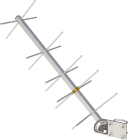
11 dBi GOES Yagi RHCP Antenna with Mounting Hardware
The 25316 is a 400 MHz RHCP 11 dBi Yagi antenna that must be aimed at the right azimuth and inclination to communicate with the assigned satellite. A TX antenna is required for TX321 operation.
OrderableCOAXNTN
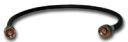
RG8 Antenna Cable with 2 Type N Pin (Male) Connectors
The COAXNTN-L is used to connect a TX antenna to the TX321 RF output or to an in-line surge protector.
Orderable31329
Surge Protection Kit, Type N to N, 100 to 512 MHz
The 31329 is used to protect the TX321 by arresting electrical surges experienced over the TX antenna coaxial cable.
Orderable21212
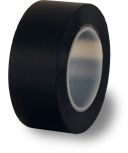
Black Cold Shrink Tape
The 21212 is used to protect exposed RF connectors, such as those on the antennas and on surge protectors.
Orderable31182
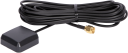
27 dBi GPS Antenna with 3 V Magnetic Mount and SMA Connector
The 31182 is a GPS antenna with integrated coaxial cable. It connects directly to the TX321 GPS input.
Orderable17992
28 dBi 3.3 V active GPS Antenna without Cable
The 17992 requires the purchase of coaxial cable to connect it to the TX321 GPS input or in-line surge protection.
Orderable45005
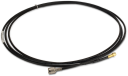
GPS Antenna Cable
The 18017 coaxial cable connects the 17992 GPS antenna directly to the TX321 transmitter. The cable is terminated with a TNC and an SMA connector.
OrderableCOAX3NT
LMR195 Antenna Cable with Type N Pin (Male) and TNC Pin (Male) Connectors
The COAX3NT-L is used to connect the 17992 GPS antenna to a 31326 or 31324 in-line GPS surge suppressor. The COAX3NT-L is an LMR195 coaxial cable fitted with a Type N Male plug connector on one end and a TNC Male plug connector on the other end.
Orderable31326
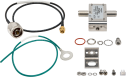
Surge Protection Kit, GPS Antenna Type N to SMA
The 31326 is used to protect the TX321 GPS RF input by arresting electrical surges to ground. Usage is optional. The 31326 is a GPS RF surge protection kit with flange mounting bracket. It may be flange-mounted to an enclosure backplate or bulkhead-mounted through an enclosure wall. One side of the surge protector connects to the TX321 GPS receiver. The other side connects to the GPS antenna cable. The surge protector passes up to ±6 Vdc, commonly needed for active GPS antenna applications. The 31326 is not compatible with the 31182 or 18017-L without a Type N to SMA adapter.
Orderable30626
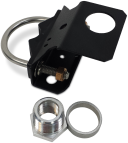
3/4 in. IPS or GPS Antenna Mounting Stand
The 30626 is used to mount the 31182 magnetic mount antenna or 17992 bullet antenna to a tripod mast, tower leg, or crossarm.
Orderable7623
3/4 IPS 10 in. Aluminum Pipe with Threads
This aluminum 0.75" IPS threaded pipe has a 10" length. The 7623 allows attachment of a 03001 Wind Sentry or GPS antenna to a CM202, CM204, or CM206 crossarm via a 1049 Nu-Rail fitting or CM220 right-angle bracket.
Orderable1049
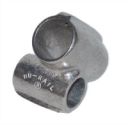
3/4 x 1 in. Nu-Rail Crossover Fitting
The 1049 Nu-Rail is used to attach the 7623 pipe to a crossarm.
Orderable



Replacement Parts
(6)27555
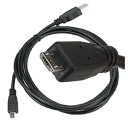
USB 2.0 Cable, Type A Pin (Male) to Micro B Pin (Male), 6/6.5 ft
The 27555 is a USB Type A to Micro B, pin (male)-to-pin (male) cable, 6 to 6.5 ft long. It connects devices using the Micro B interface to a USB port on a computer.
OrderableSC12
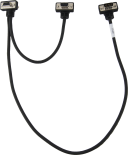
Robust CS I/O Cable, 2 ft
The SC12 is our standard cable for connecting the data logger's 9-pin serial I/O port to most peripherals with a 9-pin port. ts 9-pin pin (male) connector attaches to the data logger's CS I/O port, and the two 9-pin socket (female) connectors can attach to peripherals or interfaces.
Orderable505
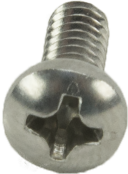
Screw #6-32 x .375 Pan Phillips
These screws, along with the 6044 grommets, are commonly used together to secure our equipment to the backplates of our enclosures.
Orderable6044
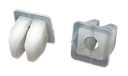
Grommet for #6 or #8 Screw
These grommets are commonly used with the 505 screws to secure our equipment to the backplates of our enclosures.
Orderable3768
2-Pin Screw Terminal Plug Connector
This green, plug-in power connector provides screw terminals for connecting the 12 V and GND wires of the datalogger's power supply.
Orderable31440
Power Cable Set of Red and Black Wires, 24 in.
The 31440 may be ordered to replace a damaged or lost wire set.
Orderable



Compatibility
Power Supply
Typical power supply is a BP12 12 Ahr or BP24 24 Ahr battery, CH150 or CH200 regulator, and an SP10 or SP20 solar panel. The BP85 or a user-supplied deep-cycle rechargeable battery can be used if the system contains higher power consumptive devices such as continuous bubblers or heated rain gages.
Note: Because of the peak power draw during transmit, do not connect to the 12V output of a data logger.
Compatible Products
(8)CR6
High-Capacity Data Acquisition System
OrderableNotes—CR310
Measurement and Control Datalogger
OrderableNotesThe CR310 requires a null modem cable, pn 18663.
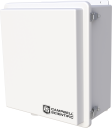
ENC10/12R
Raised Lid Enclosure, 10 x 12 inches
OrderableNotesWhen installing the TX321 into the ENC10/12R, it must be mounted flat or a right-angle serial connector must be used, such as that offered by the SC12 or a ribbon cable.
ENC12/14
Weather-Resistant Enclosure, 12 x 14 inches
OrderableNotesWhen installing the TX321 into the ENC12/14, it must be mounted flat or a right-angle serial connector must be used, such as that offered by the SC12 or a ribbon cable.
ENC14/16
Weather-Resistant Enclosure, 14 x 16 inches
OrderableNotesWhen installing the TX321 into the ENC14/16, it must be mounted flat or a right-angle serial connector must be used, such as that offered by the SC12 or a ribbon cable.
ENC16/18
Weather-Resistant Enclosure, 16 x 18 inches
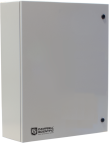
OrderableNotes—ENC24/30
Painted Steel Enclosure, 24 x 30 inches
OrderableNotes—ENC24/30S
Stainless-Steel Enclosure, 24 x 30 inches
OrderableNotes—
Incompatible Products
(1)
Related Resources
Case Studies

Documents
- Technical Paper
TX321/TX320 Firmware Update Procedure
December 2018
View Document - Brochure
TX321 GOES and Meteosat Satellite Data Transmitter
August 2017
View Document - Manual
TX321 Transmitter
May 2019
View Document - Compliance
TX321-M EU Declaration of Conformity
October 2016
View Document
Showing 4 of 7 results
See all DocumentsDownloads
- OS and FirmwareTX321 / TX320 GPS Updatev4
December 18, 2019
This download is a zip file that contains new firmware v11.11 and v10.23 for the G6 radio internal to the TX321 and v8.04 for the G5 radio internal to the TX320. The file also contains the software package that uploads the new firmware and the TX321 / TX320 firmware update procedure.
- Software ApplicationsTX320 & TX321 USB Driversv2.08.28
March 5, 2013
TX320 & TX321 USB Drivers for the Windows operating system. 32 and 64 bit support for Windows 8, Windows 7, Windows Vista and Windows XP. Note: Drivers should be loaded before plugging the TX320 or TX321 into the computer.
Services Available
- Repair
- No
- Calibration
- No
- Free Support
- No