Case Studies
Real-world project outcomes and implementation stories from Campbell Scientific customers
Florida: Sampling the Atmospheric Boundary Layer
Calculating turbulence fluxes and turbulence kinetic energy
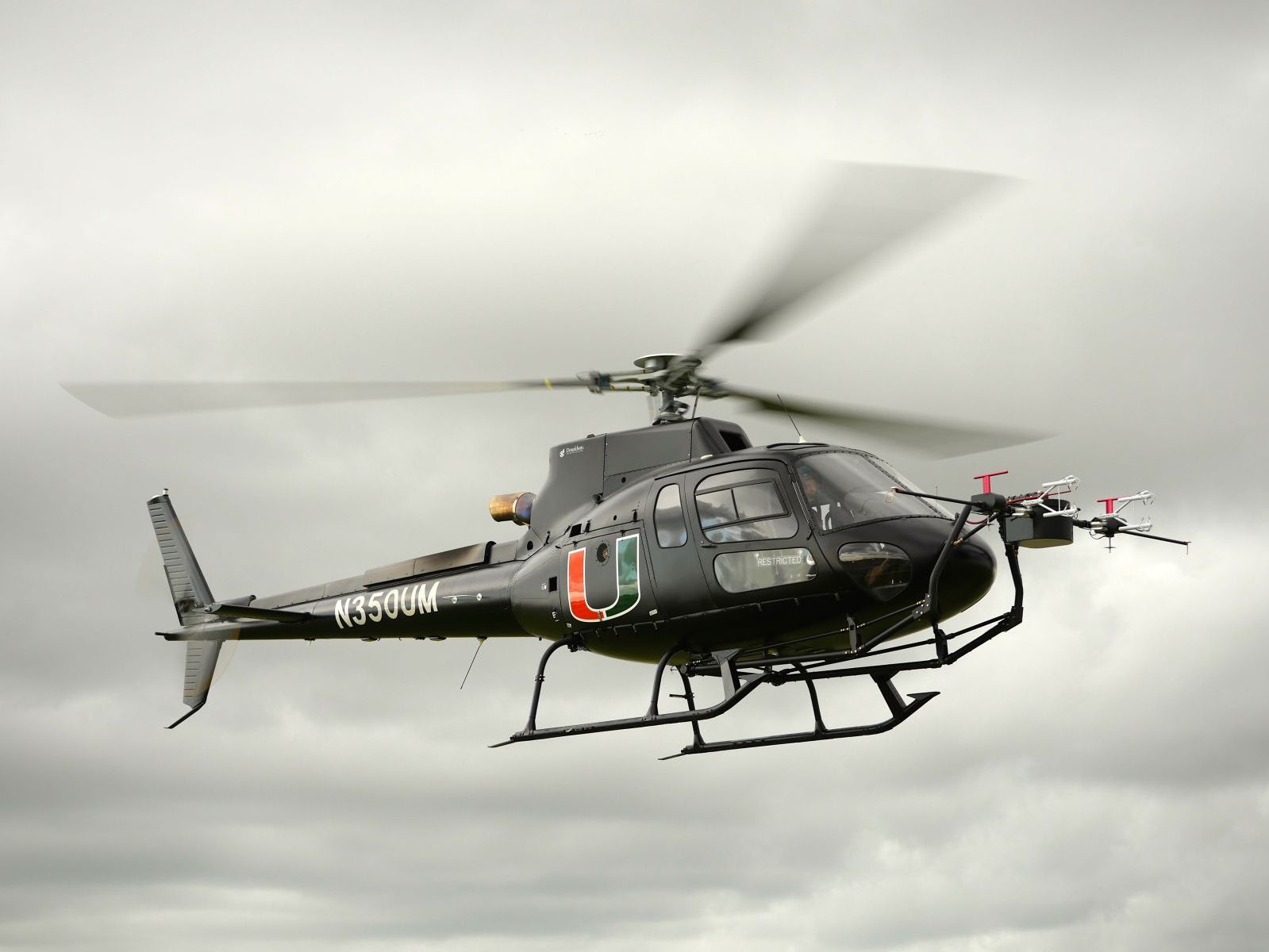
Understanding the spatial variability of the Earth’s atmospheric boundary layer—including the surface layer near the area where significant gas and energy exchanges occur—remains a challenge. Increased knowledge in this domain can significantly improve our capability to simulate the climate as well as increase our meteorological forecast accuracy. The University of Miami’s Helicopter Observation Platform (HOP), equipped with two Campbell Scientific IRGASON™ systems, has the ability to sample a large volume of the atmospheric layer—including close to the Earth’s surface—over a short amount of time.
The IRGASONs installed on the nose of the HOP are used to measure wind, temperature, air moisture, and CO2 for the purpose of calculating turbulence fluxes (momentum, sensible and latent heat, CO2) as well as turbulence kinetic energy.
Installing the IRGASON systems on the HOP was a significant challenge. Using the aircraft’s electrical power systems for purposes not related to aircraft avionics was not a simple task, as there are numerous potential disturbances from the sensors to the aircraft avionics that needed to be assessed and tested. To be successful, the team placed the sensors in an area where the air would remain undisturbed by the aircraft and dampen the aircraft vibrations that could affect the sensors and the data collected.
More specifically, the two IRGASONs were coupled with a high-frequency inertial system that provides pitch, yaw, and roll movements to help eliminate the impacts of the aircraft movements on the collected data. The Campbell Scientific team tuned the IRGASONs to perform better at the aircraft's airspeed (approximately 30 m/s). The Empirical Mode Decomposition (EMD) technique is used to process the data and isolate turbulence from other waves present in the observed data.
So far, the team running the HOP has focused on collecting data relating to the marine boundary layer's structure to better understand the energy and CO2 exchanges between the atmosphere and the ocean during the summer season. The team is still in the process of analyzing the large dataset they have collected and are looking forward to sharing their insights in due course!