BaroVue 30
BaroVue 30
Coming SoonDigital Barometer
Pricing
Configuration
Sign in for option pricing- Precision Digital Barometer -60 to +85C Campbell Calibration46684
- Precision Digital Barometer -60 to +85C Campbell Calibration46685
- Precision Digital Barometer -60 to +85C -CC Campbell Calibration46686
- Precision Digital Barometer -60 to +85C ISO 17025 Calibration46687
- Precision Digital Barometer -60 to +85C ISO 17025 Calibration46688
- Precision Digital Barometer -60 to +85C ISO 17025 Calibration46689
Select a configuration to add to your quote
- Model:
- BaroVue 30
- Item Number:
- BaroVue30
- Warranty:
- 3 years
Overview
For aviation weather, meteorological networks, and other monitoring applications, precise atmospheric pressure is essential for smooth flight operations, accurate numerical weather predictions, and trusted data of record. These records support research, emergency planning, and regulatory agencies globally as critical decisions are made and moved upon.
The BaroVue™30 is purpose-built for that role. It combines Trench-Etched Resonant Pressure Sensor (TERPS) technology, specified with drift less than 0.05 hPa/year, with the most precise measurement circuitry and onboard flexibility to fit into the observation network around it. Available in one-, two-, or three-cell configurations, it can support many different measurement and redundancy requirements.
The BaroVue 30 is also designed with long-term field operations in mind. Flexible communications make it easier to integrate into new or existing systems. Onboard data logging adds another level of data resilience, and 0.05 hPa/year stability limits drift and extends calibration intervals—a true cost saving over the sensor's lifetime.
All BaroVue 30 sensors are fully calibrated, adjusted, and traceable to national standards with full documentation. For organizations that require even more confidence in their observation networks and long-term records, the BaroVue 30 can be purchased with a calibration performed in an accredited ISO/IEC 17025 lab with documentation.
Note: A 1 m (3.28 ft) cable ships with every BaroVue 30. Only order a cable accessory as a replacement or for a non-standard length. Cable lengths up to 152.4 m (500 ft) are supported.
Key Advantages
Designed for aviation Automated Weather Observing System (AWOS) and the most discerning meteorology organizations
Technical Description
The BaroVue 30 measures atmospheric air (barometric) pressure using TERPS technology. Each TERPS transducer produces a frequency output that varies with applied pressure. The BaroVue 30 resolves that frequency output as well as the reference frequency and calculates absolute pressure once every second with 0.001 hPa resolution with measurement uncertainty within ±0.10 hPa, meeting World Meteorological Organization (WMO) guidelines for surface observations.
The BaroVue 30 is available with one, two, or three independent TERPS sensing elements. In the three-cell configuration, the reported pressure is the median of the three elements, so an excursion on any one element does not reach the output. In the two-cell configuration, the two elements are averaged and can be compared against each other to detect disagreement.
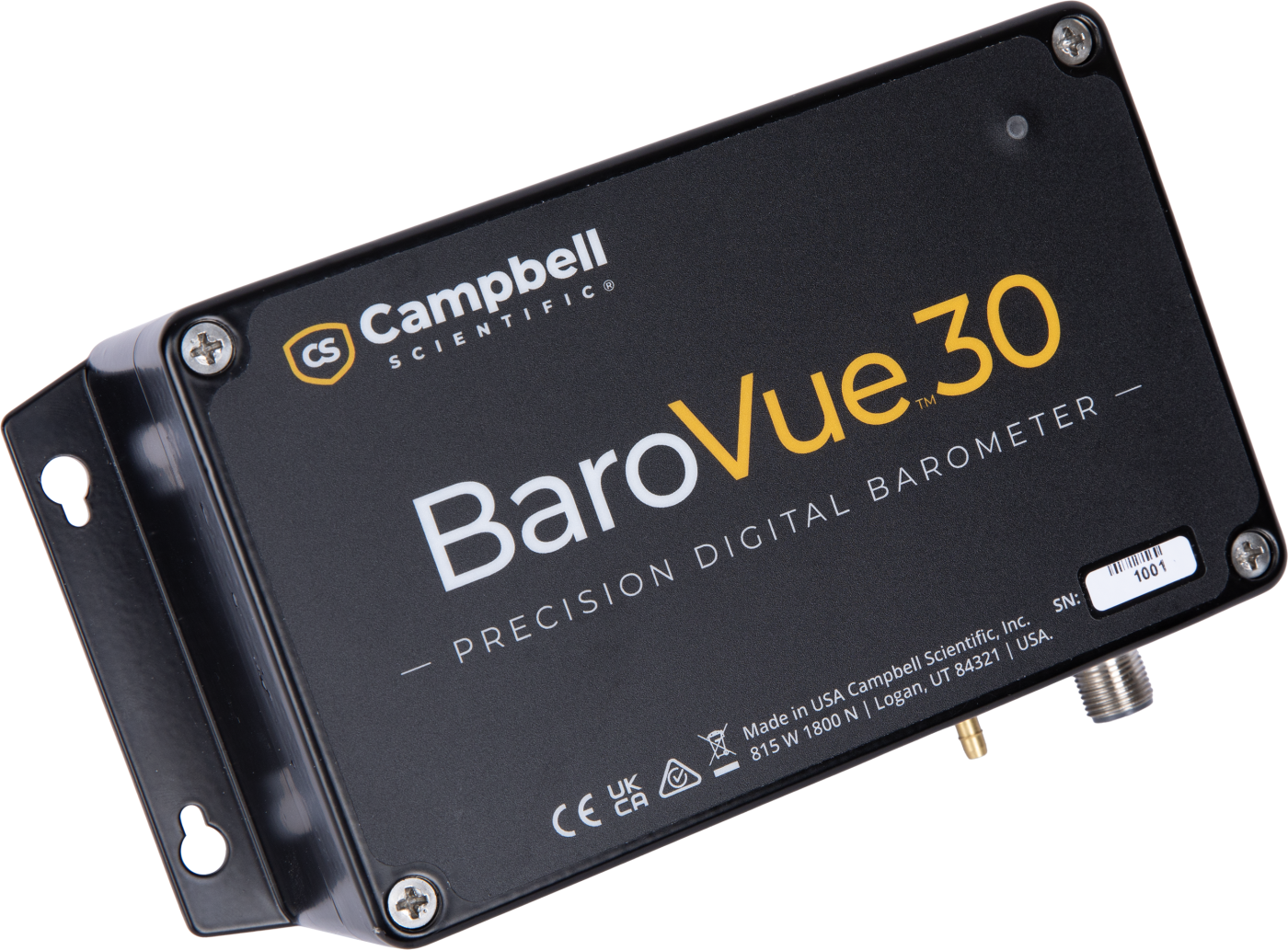
Onboard data logging retains more than two years of 1 Hz pressure measurements. The BaroVue 30 communicates over SDI-12, RS-232, or RS-485 with SDI-12 able to run concurrently with either serial protocol. A USB-C interface provides configuration, data access, and power during field service.
Housed in an IP65-rated aluminum enclosure measuring 15.75 x 9.91 x 5.84 cm (6.2 x 3.9 x 2.3 in.), the BaroVue 30 operates across a temperature range of -60° to +85°C. The sensor mounts to a diamond backplate or, with the DIN rail mounting kit, to a standard DIN rail, connecting through an M12 eight-pin connector on a shielded, twisted-pair cable at lengths verified up to 152.4 m (500 ft).
Exceeding WMO Tender Recommendations
The Guide to Instruments and Methods of Observation (WMO-No. 8, 2024 ed.) provides guidance for sensor performance requirements found in national tender specifications. The BaroVue 30 meets or exceeds these recommendations:
- Range: 450 to 1150 hPa against a required 500 to 1080 hPa range
- Response Time: <2 s time constant compared with WMO’s 2 s response time
- Operating Temperature Range: -60° to +85°C against -40° to +55°C
- Stability: 0.05 hPa/year exceeds WMO’s 0.3 hPa/year by nearly six times
- Uncertainty: ±0.10 hPa at 20°C meets the 0.10 hPa WMO-recommended threshold
- Reported Resolution: 0.001 hPa resolution compared to the WMO recommendation of 0.1 hPa, which is 100 times finer
Flexible Cell Configurations
Available with one, two, or three independent pressure cells, the BaroVue 30 supports a range of measurement and redundancy requirements.
Concurrent Dual Communications
SDI-12 v1.4 runs concurrently with a bi-directional serial interface over either RS-232 or RS-485. The ASCII serial protocol supported on the BaroVue 30 is built to perfectly match that used on the Vaisala PTB330, allowing these sensors to be interchangeable and used in any system supporting the protocol. The BaroVue 30 reports into existing AWOS host software without changes to that software.
Onboard Data Logging
The BaroVue 30 stores more than one year of 1 Hz pressure measurements onboard, providing additional data resiliency directly at the sensor.
Built for Demanding Environments
The operating range of -60° to +85°C spans 145 K, against the -40° to 55°C minimum in WMO-No. 8, 2024 ed. An internal heater holds the electronics at -40°C when the ambient temperature falls between -60° and -40°C.
Simpler Field Service
The externally accessible IP65 USB-C interface allows technicians to service, configure, and power the BaroVue 30 during maintenance without opening the enclosure or interrupting measurements.
Aviation and WMO Processed Outputs
The BaroVue 30 calculates altimeter settings—such as QNH and QFE as well as the three-hour tendency code using the standard WMO and ICAO methods—which are then available for systems to automatically ingest.
Benefits
- Reference-grade measurements
- Long-term stability
- Exceeding WMO tender recommendations
- Flexible one-, two-, or three-cell configurations
- Concurrent dual communications
- Onboard data logging
- Built for demanding environments
- Simpler field service
- Aviation and WMO processed outputs
Specifications
- Sensor Technology
- Trench-Etched Resonant Pressure Sensor (TERPS)
- Sensing Elements
- One, two, or three independent pressure cells
- Reported Resolution
- 0.001 hPa
- Measurement Uncertainty
- ±0.10 hPa at 20°C±0.15 hPa full range
- Measurement Noise
- <0.03 hPa RMS
- Long-Term Stability
- 0.05 hPa/year
- Pressure Range
- 450 to 1150 hPa
- Time Constant
- 2 s to 63% of a step change
- Measurement Rate
- 1 Hz over serial communications
- Operating Temperature Range
- -60° to +85°C
- Digital Interfaces
- SDI-12 v1.4, RS-232, RS-485
(SDI-12 can operate concurrently with RS-232 or RS-485; serial ports are compatible with the Vaisala PTB330 serial protocol.)
- Processed Outputs
- Include QFE, QNH, three-hour pressure tendency code
- Local Service Port
- USB-C
(configuration, data access, and power)
- Onboard Data Logging
- 1+ year of 1 Hz pressure data
- Supply Voltage
- 9 to 36 Vdc
(USB-C supplies 5 V for setup and test only)
- Overpressure Limit
- >5000 hPa absolute
- Operating Current
- 29.62 mA at 9 VdcHeater approximately 1.3 A while active
- Mounting Description
- Diamond backplate; standard DIN rail with mounting kit
- Cable Connector Type
- M12 eight-pin connector on shielded, twisted-pair cable at lengths verified up to 152.4 m (500 ft)
- Desiccation
- Replaceable desiccant is in the sensor housing. In-line desiccant is available as an accessory.
- Calibration
- Standard factory calibration is traceable to NIST or another National Metrology Institute (NMI) with each BaroVue 30. Optionally, ISO/IEC 17025-accredited calibration certificates and a measurement uncertainty record are also available.
- Enclosure Material
- IP65-rated aluminum
- Enclosure Dimensions
- 15.75 x 9.91 x 5.84 cm
(6.2 x 3.9 x 2.3 in.)
Common Accessories
(2)39677
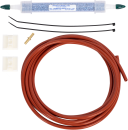
Inline Desiccant Kit for Barometers
The 39677 inline desiccant is used to vent a barometer connected to a pressure port.
Orderable39421
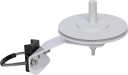
R. M. Young Pressure Port with Offset Bracket
The 39421 provides an effective static pressure inlet for a barometric pressure sensor. Ambient wind of 20 m/s (44.7 mph) blowing over a typical barometer inlet tube can cause pressure errors as great as 3 hPa. This pressure port minimizes these errors using its unique parallel plate design, which effectively slows air velocity at the pressure inlet. In addition, the simple internal baffle system creates a barrier to water and snow intrusion into the barometer.
Orderable
Replacement Parts
(2)38403
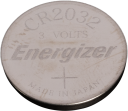
3 V Coin Cell Lithium Battery
The BaroVue™30 is equipped with a 3 V lithium battery that ensures the continued functionality of the sensor with intermittent power or data. After extended hours of power disruption or as part of routine maintenance, the 38403 may be purchased to replace the battery inside the RainVue interface. The 38403 is a CR2032X 240 mAh coin cell battery.
OrderableCABLE8PIN
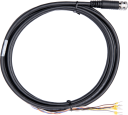
24 AWG Eight-Conductor Cable with M12 Eight-Pin Connector
This replacement cable is typically used with an analog sensor that has an M12 plug connector to connect it to a data logger with wiring terminals. The CABLE8PIN has an M12, eight-pin socket connector on one end and terminates with ferruled wires. This cable is ideal for use in outdoor environments.
Orderable