Fire Weather Stations
How We Can Help You
Campbell Scientific has manufactured thousands of automated weather stations. Our weather stations are known for their versatility and reliability, even in harsh environments. These features make them ideal for fire weather monitoring. Several configurations of our fire weather stations are available, but all of our fire weather stations monitor, record, and transmit meteorological data relevant to fire danger prediction. Our measurement instrumentation is also used for fire research.
Sensors used in Fire Weather Stations
Our fire weather stations are equipped with a suite of high quality meteorological sensors for monitoring wind speed, wind direction, precipitation, air temperature, and relative humidity. Sensors to measure fuel moisture, fuel temperature, soil water content, soil temperature, and solar radiation can also be added to a fire weather station.
Telemetry
Data can be transmitted over a variety of telecommunication options, including satellite, telephone, cell phone, and radio. In the United States, GOES1 satellite telemetered data can be collected via NIFC2 and stored to WIMS3 or collected directly from NESDIS4 using Remsoft's WeatherPro and NESDIS module. NFDRS5 indices are calculated using WIMS or WeatherPro. Our High Data Rate GOES transmitter, the TX312, features transmission rates of 1200, 300, and 100 bps.
Campbell Scientific equipment can interface to many sensors with different output types. Our dataloggers can also measure large numbers of sensors. The versatility of the dataloggers allow them to serve more than one purpose. Our equipment has been used for fire research during prescribed burns, and monitored conditions near fire lines. A suitably sited fire weather station could also be used for avalanche forecasting in the winter or serve as a year-round hydrological monitoring station with the addition of a water-depth sensor.
Fire Weather Station Benefits
- Sensors such as wind speed, wind direction, air temperature, relative humidity, solar radiation, fuel temperature and fuel moisture are commonly used in our systems.
- Data transfer options include: phone, cellphone, GOES satellite telemetry, and radio. You can also call the fire weather station via a hand-held radio and receive a verbal report of site conditions.
- Our weather stations have proven reliability in harsh environments worldwide.
- Fire weather stations can do double duty:
ET calculation, hydrologic monitoring, avalanche forecasting, and more. - Stations provide on-board mathematical and statistical processing.
- Stations are compatible with Remsoft's WeatherPro software.
- Maintenance contracts are available.
Quick Deployment Weather Station
Our RAWS-F Fire Weather Quick Deployment Station is ideal for prescribed burns or other temporary installations. Customers can set up the station in as little as 10 minutes—without tools. Each RAWS-F station is preprogrammed to monitor wind speed and direction, air temperature and relative humidity, precipitation, barometric pressure, and solar radiation sensors. This program complies with the National Fire Danger Rating System (NFDRS) weather station standards.
A RAWS-F station consists of an aluminum environmental enclosure mounted to a 6-ft tripod. The enclosure houses and protects a CR1000 datalogger and a 12-V battery that is recharged via a solar panel or an AC transformer. To facilitate sensor connection, the outside of the enclosure has color-coded, keyed connectors. A wiring panel is also provided allowing the RAWS-F to measure additional sensors.
Communication options include our GOES satellite transmitter and the VSP3 Vosponder Voice Radio Interface. The Vosponder allows customers to call a RAWS-F station via a hand-held radio and receive verbal reports of real-time conditions. Our RAWS-F station is compatible with other communication equipment such as telephones, digital cellular transceivers, and RF.
Permanent Weather Stations
Campbell Scientific provides a wide selection of sensors and data transfer peripherals for configuring a custom station that matches the exact requirements of your application. Our fire weather stations feature simplified installation and operation with a standard suite of sensors, a prewired datalogger enclosure, color-coded sensor connectors, and a fixed program in the datalogger. Custom weather stations are configured from a wider selection of sensors and data transfer peripherals, allowing for greater flexibility in matching an application's exact requirements. Permanent fire weather stations typically use 20-foot instrumentation towers. 10- and 30-foot instrumentation towers and 6-, 10-, 15-, and 20-foot tripods are also available.
Dataloggers for Fire Weather Stations
Our measurement systems are based around programmable dataloggers that measure the sensors, then process, store, and transmit the data. We offer a family of rugged, reliable dataloggers, but the CR1000 is usually suitable for fire weather applications. Our dataloggers have programmable execution intervals, wide operating temperature ranges, on-board instructions, and ample input channels for commonly used sensors. Our dataloggers interface directly to most sensors, eliminating external signal conditioning.
Data are typically viewed and stored in the units of your choice (e.g., wind speed in mph, m/s, knots). Measurement rates and data recording intervals are independently programmable, allowing calculation of 15-minute, hourly, and daily data values from 1-minute or 1-second measurements, for example. Conditional outputs, such as rainfall intensity and wind gusts, can also be recorded. The program can be modified at any time to accommodate different sensor configurations or new data processing requirements. If needed, channel capacity can be expanded using multiplexers, including a model designed specifically for thermocouples.
1Geostationary Operational Environmental Satellite
2National Interagency Fire Center
3Weather Information Management System (database)
4National Environmental Satellite, Data, and Information Service
5National Fire Danger Rating System
Products
Browse All ProductsMore Details
Our fire weather stations are built to deliver reliable data to support critical fire weather forecasting, early detection and response, and fire weather research. We provide a range of systems and sensors designed specifically for fire weather applications.
With decades of experience in environmental monitoring and data-acquisition system design, we offer both turn-key and fully customizable fire weather station solutions:
- Quick Fire* turn-key stations allow for fast deployment and rapid access to high-quality.
- Customizable stations give you the flexibility to choose the exact sensors, communications, and configuration your application requires.
Whether you need to deploy quickly or tailor a system to precise specifications, our solutions ensure you get the dependable fire weather data you rely on.
Sensors Used in Fire Weather Stations
Our fire weather stations are equipped with a suite of high-quality meteorological sensors for monitoring wind speed, wind direction, precipitation, air temperature, relative humidity, rainfall, and more. Sensors to measure fuel moisture, fuel temperature, soil water content, soil temperature, and solar radiation can also be added to a custom fire weather station. Campbell Scientific data loggers can interface with many sensors with different output types, and they can measure large numbers of sensors.
We offer a variety of products that can be used to create systems for fire weather stations. Many of the major components used to create these systems are listed below. Please let us know if we can help you configure a system.
- Quick Fire Remote Automated Fire Weather Station*
- ClimaVue™50 G2 Compact, Digital, SDI-12 Weather Sensor
- CS650 30 cm Soil Moisture and Temperature Sensor
- CS506 Fuel Moisture Sensor
- CS205 10-Hour Fuel Temperature Stick (without sensor)
- CS320 Digital Thermopile Pyranometer
- 05103 Wind Monitor
- RainVue™10 SDI-12 Precipitation Sensor with Plastic Funnel
- QST6 6 ft Quick-Setup Tripod for Temporary Installations
Telemetry
Data can be transmitted over a variety of telecommunications options. The Quick Fire* system can be ordered to communicate over USB, cellular, Wi-Fi, and/or satellite. Custom systems can communicate over USB, cellular, Wi-Fi, satellite, or radio.
Quick Deployment Remote Automated Fire Weather Station
The Quick Fire Remote Automated Fire Weather Station (RAWS)* is engineered for rapid deployment. It is ideal for providing hyperlocal data on-site at prescribed burns, densifying weather coverage in high-risk regions, or supporting any temporary installation for fire operations where time is critical.
This system is designed for fire management teams who need speed and simplicity in the field. The entire system can be fully deployed by a single operator in under 30 minutes, with minimal tools or technical expertise required.
Based on the Canadian Forest Fire Danger Rating System (CFFDRS), the Quick Fire* comes pre-programmed to calculate and output key fire weather indicators, including:
- Fine Fuel Moisture Code (FFMC)
- Duff Moisture Code (DMC)
- Drought Code (DC)
- Initial Spread Index (ISI)
- Buildup Index (BUI)
- Fire Weather Index (FWI)
- Fire Danger Code (FDC)
Permanent Weather Stations
Campbell Scientific provides a wide selection of sensors and data transfer peripherals for configuring a custom station, allowing for greater flexibility to match your application’s exact requirements. Contact us to begin designing a system to meet your unique needs.
Data Loggers for Fire Weather Stations
Our measurement systems are based around programmable data loggers that measure the sensors, then process, store, and transmit the data. We offer a family of rugged, reliable data loggers to choose from. Our data loggers have programmable execution intervals, wide operating temperature ranges, on-board instructions, and ample input channels for commonly used sensors. Our data loggers interface directly with most sensors, eliminating external signal conditioning. Many of our data loggers are available with built-in remote communications modules to simplify the data-acquisition setup.
When customizing data-acquisition systems for fire weather, data can be viewed and stored in the units of your choice (e.g., wind speed in m/s, mph, etc.). Measurement rates and data-recording intervals are independently programmable, allowing data tables to be output at any desired interval. Conditional outputs, such as rainfall intensity and wind gusts, can also be recorded. The program can be modified at any time to accommodate different sensor configurations or new data processing requirements. If needed, channel capacity can be expanded using multiplexers or other terminal expanders.
*Currently, Quick Fire is only available from our Campbell Scientific Canada regional office.
Case Studies
New Zealand: Fire Weather Network
Monitoring fire danger across New Zealand
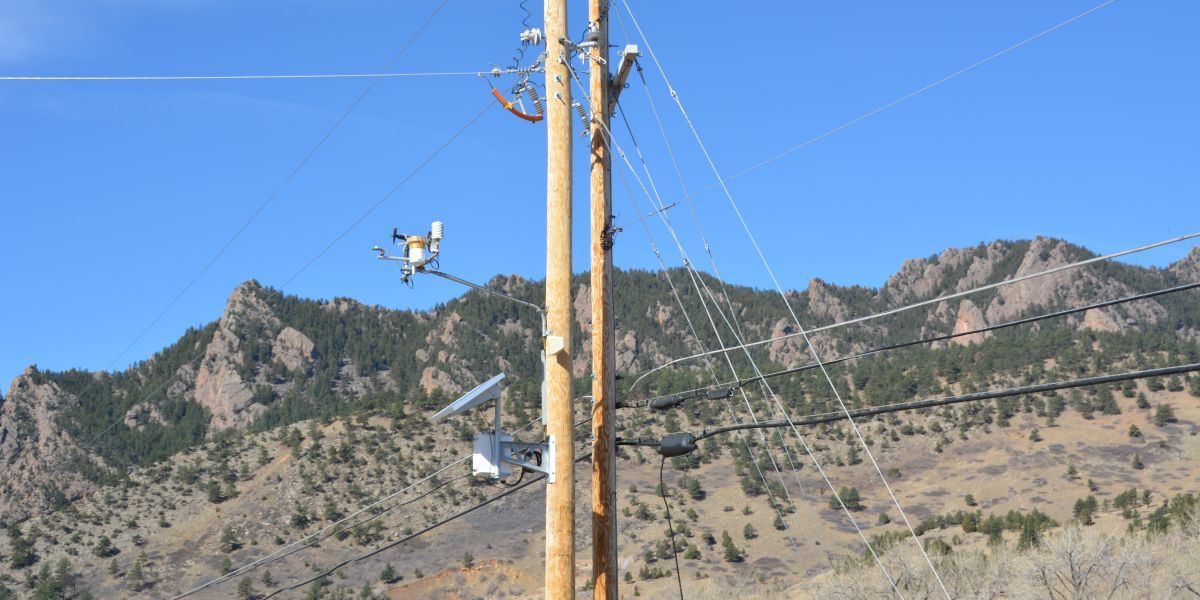
Southwestern U.S.: Building Resilient Fire Weather and Utility Monitoring Systems
Collaborating for integrated, end-to-end communications solutions