TGA100

Trace Gas Analyzer System


Retired Product: Replaced by TGA100A

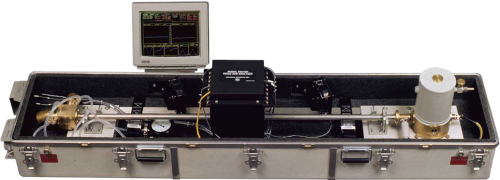
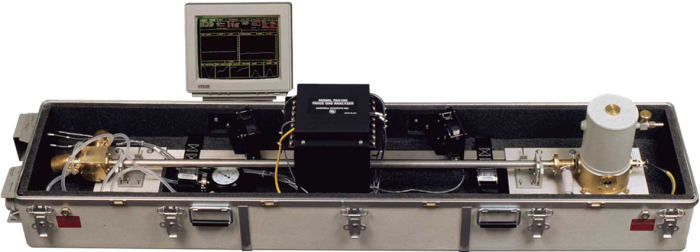
The Trace Gas Analyzer measures gas concentration using tunable diode laser absorption spectroscopy (TDLAS). This technique provides high sensitivity, speed, and selectivity. The TGA100 is a rugged, reliable, portable instrument designed for use in the field. Its simple design allows it to measure one of a large number of gases by choosing appropriate lasers and detectors. In operation, a vacuum pump continuously pulls the sample gas through the analyzer, which measures the concentration of the target gas at a 10 Hz rate. The TGA computer provides the user interface; controlling the analyzer, and calculating, displaying, and storing data in real time. It incorporates several features that make it ideal for measuring fluxes of trace gases using gradient or eddy covariance techniques.

Theory of Operation for the Trace Gas Analyzer

The Trace Gas Analyzer measures trace gas concentrations by scanning the output wavelength of a tunable diode laser over a single, isolated absorption line of the target gas to measure its absorption spectrum. The gas flows through the sample cell at low pressure to avoid line broadening at atmospheric pressure. This makes the technique selective, avoiding interference from other species that may have absorption lines nearby.

The tunable diode laser is simultaneously temperature and current controlled to produce a linear wavelength scan centered on a single selected absorption line of the target gas. The IR radiation from the laser is collimated and passed through a 1.5 m sample cell, where it is absorbed proportional to the concentration of the target gas (Beer's Law). A beamsplitter directs most of the energy through a focusing lens to the sample detector, and reflects a portion of the beam through a second focusing lens and a short reference cell to the reference detector. A prepared reference gas having a known concentration of the target gas flows through the reference cell. The reference signal provides a template for the spectral shape of the absorption feature, allowing the concentration to be derived without measuring the temperature or pressure of the sample gas or the spectral positions of the scan samples. The reference signal also provides feedback for a digital control algorithm to maintain the center of the spectral scan at the center of the absorption line. The detector signals are amplified and converted in the TGA electronics, then digitally processed to calculate the concentration of the target gas in the sample cell.

The simple optical design avoids the alignment problems associated with multiple-path absorption cells. The number of reflective surfaces is minimized to reduce errors caused by Fabry-Perot interference.

Measurement of Trace Gas Fluxes using Micrometeorological Techniques

The TGA100 is ideally suited to measure fluxes of trace gases using micrometeorological techniques. In addition to its rugged design that allows it to operate reliably in the field with minimal protection from the environment, it also incorporates several hardware and software features to facilitate these measurements.

The TGA100's sample rate, frequency response, sensitivity and selectivity are all more than adequate to measure trace gas fluxes using the eddy covariance (EC) method. It is designed to collect three-dimensional wind data from a CSAT3 Sonic anemometer while synchronously measuring gas concentrations. It can also collect data from other instrumentation through a CSI datalogger, or through its own auxiliary analog inputs.

The TGA100 also supports the measurement of trace gas fluxes by the gradient method. Based on user-supplied parameters, the TGA100 automatically controls the switching valves and computes the mean concentration and mean gradient at one or multiple sites, then stores the results to a disk and displays the data in real-time.

Trace Gas Species Options

The TGA100 can measure gases with absorption lines in the 1 to 11 micron range, by selecting appropriate lasers and detectors. The laser dewar has up to four positions available, allowing selection of up to four different species by rotating the dewar, installing the corresponding cable, and performing a simple optical realignment. Systems have been provided to measure nitrous oxide (N2O), methane (CH4), and ammonia (NH3), but many other species can also be measured. Multiple species are measured at the same time by using multiple TGA100s in a master/slave configuration with the master TGA collecting and recording data from up to four slave TGAs.

Also, one TGA100 can be configured to measure two gases simultaneously by alternating the spectral scan wavelength between two nearby absorption lines. This technique requires that the two absorption lines be very close together; it has been used to measure two isotopomers of carbon dioxide.

Operating Environment

The TGA's rugged enclosure and simple, robust, optical design allow it to maintain alignment and operate in the field. The optics and electronics are housed in an insulated fiberglass enclosure that shock mounts the optical bench and dampens temperature variations. If the TGA100 is operated in an open environment, the optional TGA Insulated Enclosure Cover and TGA100 Temperature Controller are recommended.

The PC must be sheltered but can be located up to 150 m from the analyzer.

Laser Cooling Options

The laser must be cooled to as low as 80 K, depending on the individual laser. Two options are available to mount and cool the laser: the TGA100 LN2 Laser Dewar and the TGA100 Laser Cryocooler System.

TGA100 LN2 Laser Dewar

The TGA100 LN2 Laser Dewar holds 10.4 liters of liquid nitrogen, is mounted inside the analyzer enclosure, and includes a laser mount that can accommodate two lasers. A second laser mount can be added to accommodate an additional two lasers.

The hold time of the TGA100 LN2 Laser Dewar depends on the laser's operating temperature and the thermal conductance between the laser mount and the liquid nitrogen tank. The thermal conductance is set at the factory, depending on the laser's operating temperature, to provide at least 4 days operational hold time.

TGA100 Laser Cryocooler System

The TGA100 Laser Cryocooler System option uses a closed-cycle refrigeration system to cool the laser without liquid nitrogen. It includes a vacuum housing mounted inside the analyzer enclosure, a compressor mounted outside the enclosure, and 3.1 m (10 ft) flexible gas transfer lines (longer lines are also available). The TGA100 Laser Cryocooler System will operate continuously, with only periodic reevacuation needed to maintain the vacuum.

Similar to the TGA100 LN2 Laser Dewar, the TGA100 Laser Cryocooler System can accommodate one or two lasers, or up to four lasers with the optional second laser mount. The compressor must be sheltered and maintained at 10 to 35°C, and the gas transfer lines must be kept above 5° C. The TGA100 Laser Cryocooler System option adds 2.5 cm (1 in) to the length of the TGA100 enclosure.

Absolute Concentration Measurements

The TGA100 has a small offset error caused by optical interference. This offset error changes slowly over time, with a standard deviation roughly equal to the short-term noise. See graph at right for a typical methane concentration time series, demonstrating this effect. Offset errors have little effect on flux measurements by either the gradient or eddy covariance technique, but may be important in other applications. For measurements of absolute trace gas concentration, the offset error can be removed by switching between a nonabsorbing gas and the sample gas, using the gradient mode of operation.

At right: Methane concentration in a sample of compressed air. The short-term, long-term, and total standard deviations are: 6.5, 7.2, and 9.8 ppb.

Auxiliary Inputs/Outputs

The TGA100 has both analog and digital I/Os. All data from auxiliary inputs are sampled at 10 Hz, and are synchronized with the TGA100 concentration measurements.

  • Three analog inputs in analyzer electronics: ± 5 Vdc, 16 bits
  • Eight analog inputs in PC (optional): ± 10 Vdc, 12 bits
  • Digital input from CSAT3 Sonic Anemometer: wind speed (3 dimensions), sonic temperature, and diagnostic word
  • Two analog outputs have user-selectable ranges
  • Sixteen digital outputs used for switching sampling system valves

References to Example Applications

The TGA 100 has been used in the field for several years to measure trace gas fluxes. The following brief list gives a few examples of published results:
  • Griffis, T.J., J.M. Baker, S.D. Sargent, B.D. Tanner and J. Zhang, (2004) Measuring Field-Scale Isotopic CO2 Fluxes with Tunable Diode Laser Absorption Spectroscopy and Micrometeorological Techniques, Agricultural and Forest Meteorology., in press.
  • Bowling, D.R., S.D. Sargent, B.D. Tanner, and J.R. Ehleringer, (2003) Tunable diode laser absorption spectroscopy for stable isotope studies of ecosystem-atmosphere CO2 exchange, Agricultural and Forest Meteorology 118: 1-19.
  • Scanlon, T. M., and G. Kiely, (2003) Ecosystem-scale measurements of nitrous oxide fluxes for an intensely grazed, fertilized grassland, Geophysical Research Letters 30(16): 1852.
  • Brown, H.A., C. Wagner-Riddle and G.W. Thurtell, (2002) Nitrous oxide flux from a solid dairy manure pile measured using a micrometeorological mass balance method, Nutrient Cycling in Agroecosystems 62: 53-60.
  • Brown, H.A., C. Wagner-Riddle, and G.W. Thurtell, (2000) Nitrous oxide flux from solid dairy manure in storage as affected by water content and redox potential, Journal of Environmental Quality 29: 630-638.
  • Maggiotto, S. R., J. A. Webb, C. Wagner-Riddle, and G.W. Thurtell, (2000) Nitrous and nitrogen oxide emissions from turfgrass receiving different forms of nitrogen fertilizer, Journal of Environmental Quality 29: 621-630.
  • Warland, J.S. and G.W. Thurtell, (2000) A micrometeorological method for in situ denitrification measurements using acetylene inhibition (Short communication), Agricultural and Forest Meteorology 103: 387-391.
  • Grant, R.F. and E. Pattey, (1999) Mathematical modelling of nitrous oxide emissions from an agricultural field during spring thaw, Global Biogeochemical Cycles 13(2): 679-694.
  • Simpson, I.J., G.W. Thurtell, H.H. Neumann, G. den Hartog, and G.C. Edwards, (1998) The validity of similarity theory in the roughness sublayer above forests, Boundary-Layer Meterology 87: 69-99.
  • Wagner-Riddle, C., and G.W. Thurtell, (1998) Nitrous oxide emissions from agricultural fields during winter and spring thaw as affected by management practices, Nutrient Cycling in Agroecosystems 52: 151-163.
  • Billesbach, D.P., J. Kim, R.J. Clement, S.B. Verma, and F.G. Ullman, (1998) An intercomparison of two tunable diode laser spectrometers used for eddy correlation measurements of methane flux in a prairie wetland, Journal of Atmospheric and Oceanic Technology 15: 197-206.
  • Simpson, I. J., G.C. Edwards, G.W. Thurtell, G. den Hartog, H.H. Neumann, and R.M. Staebler, (1997) Micrometerological measurements of methane and nitrous oxide exchange above a boreal aspen forest, Journal of Geophysical Research 102(D24): 29,331-29,341.
  • Wagner-Riddle, C., G.W. Thurtell, G.E. Kidd, E.G. Beauchamp, and R. Sweetman, (1997) Estimates of nitrous oxide emissions from agricultural fields over 28 months, Canadian Journal of Soil Science 77: 135-144.
  • Wagner-Riddle, C., G.W. Thurtell, K.M. King, G.E. Kidd, and E.G. Beauchamp, (1996) Nitrous oxide and carbon dioxide fluxes from a bare soil using a micrometeorological approach, Journal of Environmental Quality 25: 898-907.
  • Wagner-Riddle, C., G.W. Thurtell, G.E. Kidd, G.C. Edwards, and I.J. Simpson, (1996) Micrometerological measurements of trace gas fluxes from agricultural and natural ecosystems, Infrared Physics and Technology 37: 51-58.
  • Simpson, I.J., G.W. Thurtell, G.E. Kidd, M. Lin, T.H. Demetriades-Shah, I.D. Flitcroft, E.T. Kanemasu, D. Nie, K.F. Bronson, and H.U. Neue, (1995) Tunable diode laser measurements of methane fluxes from an irrigated rice paddy field in the Philippines, Journal of Geophysical Research 100(D4): 7283-7290.
  • Edwards, G.C., H.H. Neumann, G. den Hartog, G.W. Thurtell, and G. Kidd, (1994) Eddy correlation measurements of methane fluxes using a tunable diode laser at the Kinosheo Lake tower site during the Northern Wetlands Study (NOWES), Journal of Geophysical Research 99(D1): 1511-1517.

    Features

    Specifications

    Measurement

    • Sample Rate: 10 Hz
    • Averaging Period: 0.1 sec
    • Frequency Response (@ 4 liter/sec flow rate): 1.6 Hz
    • Noise (0.01 to 5 Hz bandwidth: 1.5 ppbv (N2O), 7 ppbv (CH4), 2 ppbv (NH3)
    • Gradient Resolution (30 minute averaging time): 0.03 ppbv (N20), 0.15 ppbv (CH4), 0.06 ppbv (NH3)

    Analyzer Dimensions

    • Length: 211 cm (83 in)
    • Width: 47 cm (18.5 in)
    • Height: 55 cm (21.5 in)
    • Weight: 74.5 kg (164 lb)

    Optional Cryocooler Compressor Dimensions

    • Length: 31 cm (12 in)
    • Width: 45 cm (18 in)
    • Height: 38 cm (15 in)
    • Weight: 32 kg (71 lbs)

    Power Requirements

    • Analyzer: 90-264 Vac, 47-63 Hz; 50 W
    • PC: 115/230 Vac, 50/60 Hz; 150 W
    • Optional Cryocooler Compressor: 100, 120, 220, or 240 Vac, 50/60 Hz; 500 W